
Helonium: Meaning, Chemistry, History, Properties, and Importance in Science
Introduction
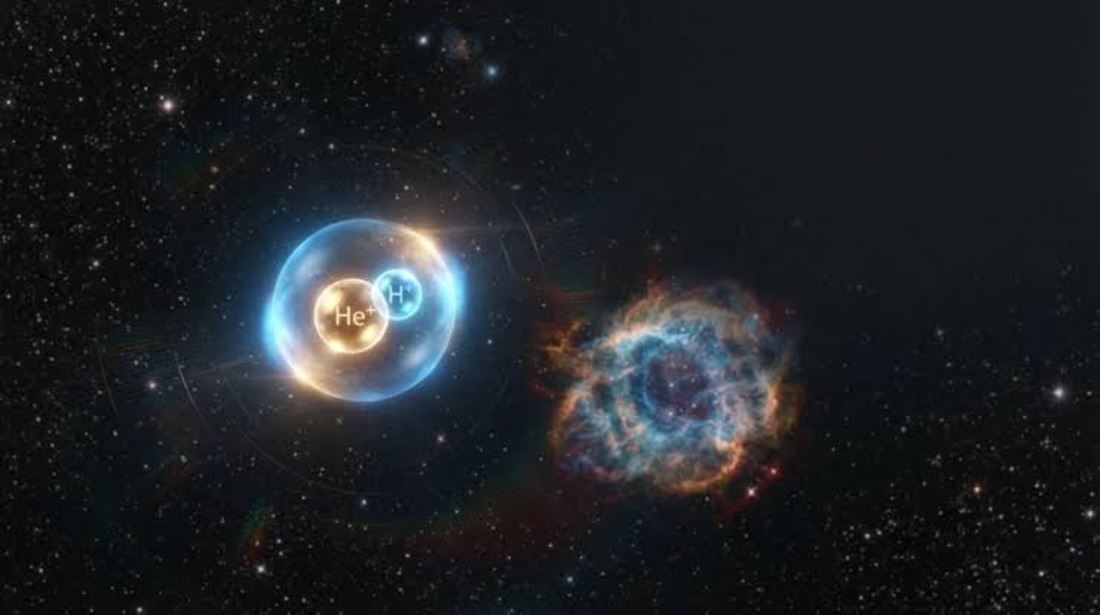
Helonium is a scientific term associated with one of the most unusual molecular ions known to chemistry. The name refers to the helium hydride ion, HeH⁺, a positively charged species formed from helium and hydrogen. Although helium is famous for being one of the least reactive elements, its interaction with a hydrogen nucleus can produce an ion with remarkable chemical and astrophysical significance.
Helonium is especially interesting because it provides an important connection between chemistry and astronomy. Scientists have studied HeH⁺ for decades because it is believed to have played a role in the chemical evolution of the early universe. It has also been detected in a planetary nebula, confirming that this unusual ion can exist naturally in space.
This article explains what helonium means, its chemical structure, history, properties, formation, astronomical importance, and the difference between helonium and similar terms.
What Is Helonium?
Helonium is a name used for the helium hydride ion, represented by the chemical formula HeH⁺. It consists of a helium atom and a hydrogen nucleus and carries a single positive electrical charge.
The structure can be understood relatively simply. A neutral helium atom contains two protons and two electrons. When helium interacts with a proton, it can form HeH⁺. The resulting species is a molecular ion rather than a conventional neutral molecule.
The positive charge is an important part of its identity. The formula HeH⁺ indicates that the combined system has one more positive charge than negative charge.
Helonium is therefore not a chemical element. It is a molecular ion that belongs to the field of molecular chemistry and chemical physics.
The Chemical Formula of Helonium
The chemical formula for helonium is:
HeH⁺
The individual components have specific meanings:
- He represents helium.
- H represents hydrogen.
- ⁺ indicates a positive charge.
The ion is also commonly called the helium hydride ion. In scientific literature, HeH⁺ is the more precise and widely recognizable notation.
Because helium has a very stable electronic configuration, forming a chemical bond involving helium is unusual. This makes HeH⁺ particularly valuable for researchers studying chemical bonding and molecular interactions.
Why Helonium Is Scientifically Unusual
Helium belongs to the noble gases. Noble gases generally have extremely stable electron configurations and therefore tend to resist chemical bonding.
This makes helium fundamentally different from elements such as hydrogen, oxygen, and carbon, which readily form ordinary chemical compounds.
HeH⁺ is unusual because helium can participate in this positively charged molecular system despite its normally low chemical reactivity. The ion is strongly bound in comparison with many other simple molecular ions, but it is also highly reactive.
Its unusual characteristics have made it an important subject in theoretical chemistry, laboratory experiments, spectroscopy, and astrophysics.
Helonium and Helium Are Not the Same
The terms helonium and helium should not be confused.
Helium is a chemical element with the symbol He and atomic number 2. It is a colorless, odorless noble gas that is chemically very stable.
Helonium, by contrast, refers to the helium hydride ion HeH⁺.
The difference can be summarized as follows:
| Feature | Helium | Helonium |
|---|---|---|
| Type | Chemical element | Molecular ion |
| Formula | He | HeH⁺ |
| Charge | Neutral | Positive |
| Contains hydrogen? | No | Yes |
| Atomic number | 2 | Not applicable |
| Common environment | Gas and many natural/industrial settings | Specialized laboratory and astronomical environments |
Understanding this distinction is important because helonium is not another name for helium itself.
How Helonium Forms
Helonium can form when a helium atom interacts with a proton. In simplified terms, the reaction can be represented as:
He + H⁺ → HeH⁺
The process involves the interaction of helium with a positively charged hydrogen nucleus.
The exact chemistry can become more complicated depending on the environment. Temperature, density, radiation, and the availability of electrons can all affect how HeH⁺ forms and survives.
In astrophysical environments, ionization and recombination processes can create conditions where helium hydride ions become possible.
The Discovery and Early Research of HeH⁺
Scientists became interested in helium hydride ions during the development of modern molecular physics and quantum chemistry.
Laboratory production of HeH⁺ was achieved in the early twentieth century, with experimental work dating to 1925. Researchers subsequently investigated its structure, energy levels, reactions, and spectroscopy.
The ion attracted particular attention because it offered scientists an opportunity to study chemical bonding involving helium.
Theoretical calculations also predicted that HeH⁺ should exist under certain astrophysical conditions. This made it an important candidate for astronomical observations.
Helonium and the Early Universe
One of the most important reasons scientists study HeH⁺ is its connection to the early universe.
After the Big Bang, the universe consisted largely of simple particles and eventually formed light elements such as hydrogen and helium. As the universe expanded and cooled, atoms began forming and increasingly complex chemical processes became possible.
Scientists believe that HeH⁺ could have been among the earliest molecular ions to form during this period.
Helium and hydrogen were abundant in the early universe, making their interaction particularly important. The formation and destruction of HeH⁺ could therefore have contributed to the earliest stages of molecular chemistry.
Although modern interstellar chemistry is far more complicated, studying HeH⁺ helps scientists understand how the universe transitioned from a collection of simple atoms and ions toward increasingly complex molecules.
The Astronomical Detection of Helonium
For many years, scientists predicted that HeH⁺ should exist in certain astronomical environments, but directly detecting it proved difficult.
A major breakthrough came in 2019, when researchers reported the detection of HeH⁺ in the planetary nebula NGC 7027.
The observation was made using the Stratospheric Observatory for Infrared Astronomy (SOFIA), an airborne observatory that carried specialized infrared instruments.
The discovery was important because it provided observational confirmation that helium hydride ions can exist naturally in space.
NGC 7027 is a hot planetary nebula containing conditions suitable for producing unusual chemical species. Its intense radiation and high-energy environment make it an excellent natural laboratory for studying ions such as HeH⁺.
Why the Detection Was Important
The detection of HeH⁺ in NGC 7027 was significant for several reasons.
First, it confirmed a long-standing theoretical prediction. Scientists had expected helium hydride ions to occur in certain hot astronomical environments, but direct observational evidence had been difficult to obtain.
Second, the discovery demonstrated that an ion associated with early-universe chemistry can still exist in modern astronomical environments.
Third, the observation provided scientists with additional information about molecular processes occurring in planetary nebulae.
The discovery therefore connected theoretical chemistry, laboratory physics, and astronomical observation.
Spectroscopy and Helonium
Spectroscopy plays an important role in identifying HeH⁺.
Molecules and molecular ions can interact with electromagnetic radiation at specific frequencies. These interactions produce characteristic spectral signatures.
Scientists can use these signatures as fingerprints. By examining radiation coming from an astronomical object, researchers can search for patterns corresponding to known molecular transitions.
The detection of HeH⁺ in NGC 7027 depended on identifying an appropriate spectral signature. This demonstrates why molecular spectroscopy is so valuable in astronomy: researchers can determine the presence of substances that are extremely difficult or impossible to collect directly.
Physical and Chemical Characteristics
HeH⁺ has several properties that make it scientifically distinctive.
It is a diatomic molecular ion, meaning that it contains two nuclei associated with two different elements. Unlike ordinary neutral molecules, it carries a positive charge.
It is also highly reactive. Under ordinary conditions, it does not behave like a stable bulk material that can simply be stored in a container.
Its unusual bonding characteristics have made it useful for testing theoretical models of molecular structure.
Because helium has a very stable electronic configuration, the interaction between helium and hydrogen in HeH⁺ is fundamentally different from the bonding seen in many familiar molecules.
Helonium in Laboratory Research
Laboratory studies of HeH⁺ allow scientists to investigate its energy levels, reactions, and spectroscopic characteristics.
Researchers can produce and examine molecular ions under controlled conditions. Such experiments help test theoretical predictions and improve understanding of molecular physics.
HeH⁺ is also important for computational chemistry. Scientists can model its electronic structure using quantum-mechanical calculations.
Because it is a relatively simple molecular system containing only two nuclei, it can serve as a useful model for testing sophisticated theories and computational methods.
Is Helonium a Stable Substance?
Helonium should not be thought of as an ordinary stable substance like water or table salt.
HeH⁺ can exist under appropriate conditions, but it is highly reactive and tends to participate in further chemical reactions. Its lifetime depends strongly on its surrounding environment.
In space, its existence is possible because specific conditions involving temperature, radiation, density, and ionization can support its formation.
This is one reason why studying HeH⁺ requires specialized equipment and techniques.
Helonium and Astrophysics
The importance of helonium extends beyond chemistry.
Astrophysicists study HeH⁺ because its presence can reveal information about physical conditions in astronomical objects. The ion’s spectral characteristics can help scientists investigate regions containing intense radiation and ionized gases.
Its connection with planetary nebulae also makes it relevant to the study of stellar evolution.
Planetary nebulae form during a late stage in the evolution of certain stars. The hot central star can emit strong radiation that interacts with surrounding gas, producing complex chemical and physical environments.
HeH⁺ can form in some of these regions, making it a useful molecule for studying such environments.
Helonium and the Term “Helionium”
Another term that can cause confusion is helionium.
Although helonium and helionium look almost identical, they refer to different scientific concepts.
Helonium is associated with HeH⁺, the helium hydride ion.
Helionium has been used in connection with a different exotic atomic system involving helium-related nuclei and antimatter.
Therefore, the spelling matters. When discussing the helium hydride ion, helonium or helium hydride ion (HeH⁺) is the relevant term.
Is Helonium an Element on the Periodic Table?
No. Helonium does not have its own position on the periodic table.
The periodic table contains chemical elements such as hydrogen, helium, carbon, oxygen, and iron. Helonium is instead a molecular ion made from existing elements.
It therefore does not have an independent atomic number.
The element helium retains atomic number 2, while hydrogen retains atomic number 1.
Why Scientists Continue to Study Helonium
HeH⁺ remains scientifically interesting because it sits at the intersection of several fields.
Chemists study its unusual bonding behavior. Physicists examine its energy levels and molecular structure. Astronomers search for its spectral signatures in space. Cosmologists consider its possible role in the chemistry of the early universe.
The simplicity of HeH⁺ also makes it useful for testing scientific theories. A system containing only helium and hydrogen may appear simple, but its unusual electronic structure creates challenging questions about molecular bonding and chemical reactions.
Frequently Asked Questions About Helonium
1. What is helonium?
Helonium is a term associated with the helium hydride ion, HeH⁺. It is a positively charged molecular ion consisting of helium and hydrogen.
2. Is helonium the same as helium?
No. Helium is a chemical element represented by He, while helonium refers to the molecular ion HeH⁺. Helium is neutral in its ordinary atomic form, whereas HeH⁺ has a positive charge.
3. Where is helonium found?
HeH⁺ can be produced under specialized laboratory conditions and can also occur in certain astronomical environments. It was directly detected in the planetary nebula NGC 7027 in 2019.
4. Why is helonium important?
Helonium is important because it provides information about unusual chemical bonding, molecular physics, and astronomical chemistry. It is also thought to have played a role in the early chemical evolution of the universe.
5. Is helonium a chemical element?
No. Helonium is not an element and does not have an atomic number of its own. It is a molecular ion made from helium and hydrogen, represented by HeH⁺.
Conclusion
Helonium, or the helium hydride ion HeH⁺, is a remarkable example of how simple atoms can produce scientifically important molecular systems. Its unusual chemistry is closely connected to the special properties of helium, one of the least reactive elements in the periodic table.
The study of HeH⁺ extends from early laboratory experiments to modern astronomical observations. Its possible role in early-universe chemistry makes it relevant to cosmology, while its detection in NGC 7027 demonstrates that it can exist in present-day astronomical environments.
Although helonium is not an element and is not encountered as an ordinary everyday substance, it remains an important subject in chemistry, physics, spectroscopy, and astronomy. Its unusual structure and connection to the earliest stages of molecular chemistry make HeH⁺ a valuable system for understanding how chemical complexity developed in the universe.
Mariam Nazir
Mariam Nazir founded Top 10 with a straightforward goal: create a website where people can find genuinely helpful, well-researched top 10 lists on the topics they actually care about.