
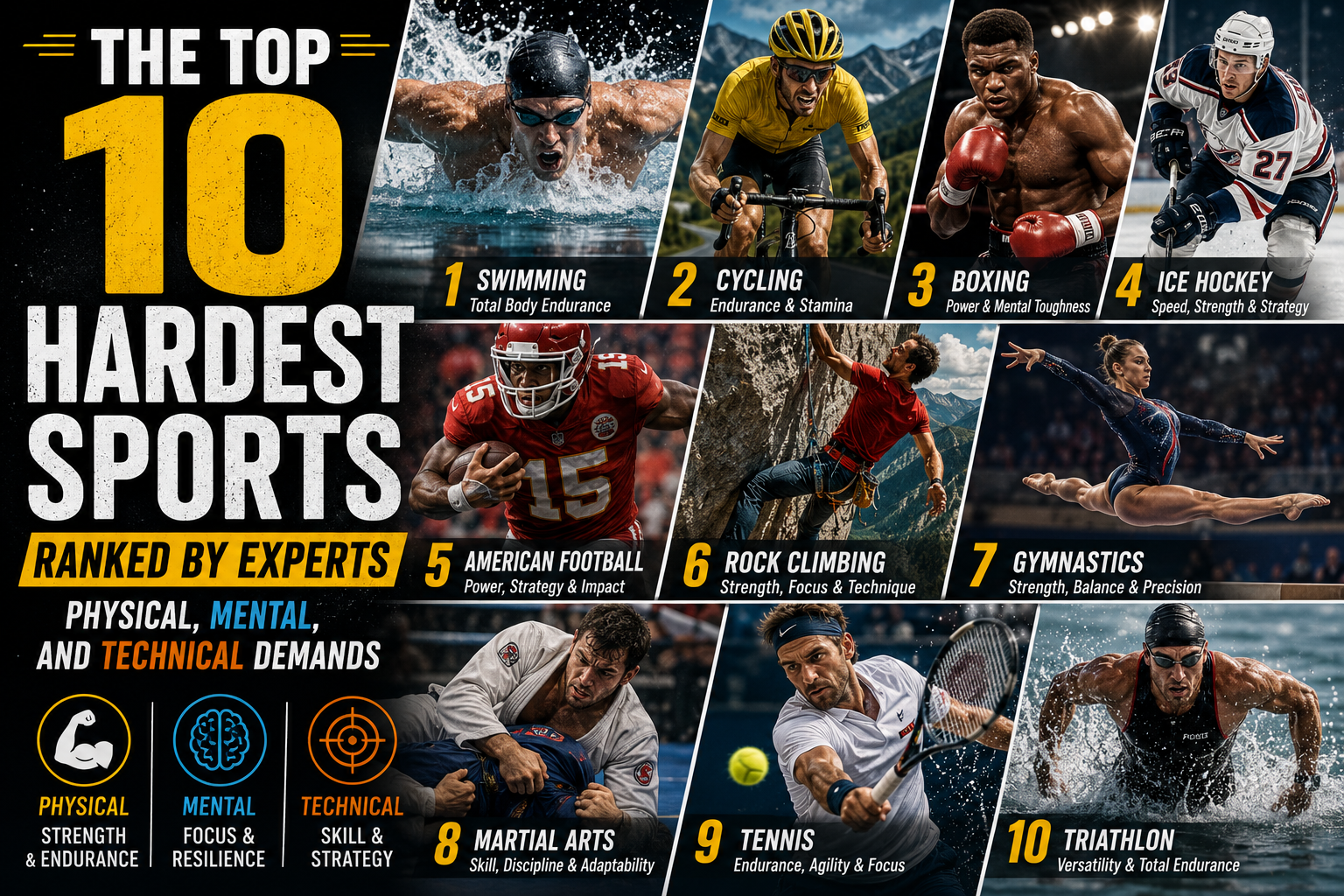
The Top 10 Hardest Sports Ranked by Experts: Physical, Mental, and Technical Demands
Ask any athlete what the hardest sport is, and you will get a different answer every single time. A marathon runner will talk about cardiovascular endurance, while a gymnast will point to the precise control over every muscle fiber. A boxer will mention the pain of taking a hit, and a water polo player will laugh while treading water for hours. The truth is that defining the top 10 hardest sports requires a multi-faceted approach. We have to consider the physical toll, the technical skill required to reach a professional level, the mental fortitude needed to compete under pressure, and the sheer risk of injury. After years of analyzing athletic performance and consulting with sports scientists, we have developed a clear criteria to cut through the debate and rank these brutal disciplines.
Our evaluation system looks at five key pillars: endurance (aerobic and anaerobic), strength and power output, neuromuscular coordination and fine motor skills, the risk of physical harm, and the psychological resilience required to perform consistently. We have also factored in the “information gain” of mastery—meaning the depth of knowledge and instinct required to read the game or environment in real-time. Sports like chess are mentally exhausting, but they lack the physical brutality of the gridiron. Conversely, powerlifting is incredibly demanding on the musculoskeletal system but does not require the same cardiovascular engine as a Tour de France cyclist. The selections on this list represent the peak of human physical endeavor, where a fraction of a second or a single mistake can mean the difference between victory and catastrophic failure. Here is the definitive ranking of the sports that push the human body and mind to their absolute limits.
Boxing: The Ultimate Test of Split-Second Strategy and Pain Tolerance
Boxing is not just about throwing punches; it is about managing pain while executing complex geometry at high speed. Fighters must have the aerobic capacity to go twelve three-minute rounds while simultaneously generating explosive anaerobic power in their combinations. The cardiovascular demand is staggering, often placing boxers among the fittest athletes on the planet. However, the defining characteristic of this sport is the constant threat of getting hit. Taking a clean punch to the head or body requires a level of physical and mental fortitude that is almost impossible to describe to someone who has never stepped into the ring. The top 10 hardest sports list would be incomplete without acknowledging that boxing requires an athlete to be a marathon runner, a sprinter, and a chess player, all while getting beaten up.
What makes the sport truly unforgiving is the strategic depth involved. A boxer must read an opponent’s feints, manage distance, and set traps over several minutes, all while their vision is blurry from sweat and their lungs are burning. The margin for error is zero; a momentary lapse in concentration leaves you exposed to a knockout punch. For the average person, the training alone—which includes roadwork, heavy bag drills, sparring, and strict weight management—is enough to break the body. Yet, fighters do this repeatedly, often in the lead-up to a single night. The combination of extreme physical output, chronic traumatic injury risk, and the isolated nature of the competition firmly cements boxing as one of the most demanding pursuits a human can undertake.
Gymnastics: The Relentless Pursuit of Perfection Under Extreme Force
While many sports reward raw power or endurance, gymnastics demands an almost inhuman level of body awareness and control. Athletes in this discipline must possess the strength-to-weight ratio of a superhero, capable of supporting their entire body weight on a single ring or performing a triple-twisting double backflip on a four-inch-wide beam. The forces exerted on the joints, specifically the wrists, elbows, and knees, are immense. A gymnast’s career is often defined by the ability to manage tendonitis and ligament tears, which are almost a given at the elite level. The sport is technically one of the top 10 hardest sports because the routine is over in a flash, but the physical preparation takes a decade of grueling repetition.
The psychological component of gymnastics is equally brutal. There is no “off” switch when you are flying through the air. The fear of falling or executing a skill incorrectly is a constant companion. Coaches often use terms like “cognitive dissonance” to describe the disconnect an athlete must create between the rational fear of injury and the physical execution of the skill. A single wobble on the balance beam or a slight under-rotation on the vault can lead to a trip to the hospital. Unlike team sports where a player can be carried by a teammate, a gymnast is alone in the spotlight. The pressure to perform flawlessly, combined with the wear and tear on the body, makes this one of the shortest, most intense careers in athletics.
Ice Hockey: The High-Speed Collision Sport Played on a Knife’s Edge
Ice hockey is often misunderstood by those who have never played it. The perception is that it is a game of fights and brute force, but the reality is far more complex. Hockey players combine the lower-body strength of a power skater with the hand-eye coordination of a baseball player, all while avoiding collisions with boards and other players traveling at thirty miles per hour. The average shift lasts about forty-five seconds to a minute, which requires 100% maximal exertion. The heart rate of an NHL player during a shift can spike to 190 beats per minute, which is a level of anaerobic intensity that is rarely matched in other sports.
The difficulty of ice hockey extends well beyond the physicality. The act of skating itself—a complex motor skill that requires precise ankle strength and balance—is a barrier to entry that makes the sport incredibly exclusive. Once the skating is mastered, the player then has to handle a small, hard disc with a stick while scanning the ice for teammates and anticipating the opposition’s movements. The “information gain” required to be an elite player is vast; you have to know where everyone is on the ice without looking directly at them. This sensory overload, combined with the inherent danger of sharp blades and high-velocity pucks, makes hockey a legitimate contender for the top spot. The physical toll of an eighty-two-game season is monstrous, with players often playing through fractures and hernias that would sideline athletes in other sports.
Mixed Martial Arts (MMA): The Complete Spectrum of Combat
If boxing is a specific art form, Mixed Martial Arts is the entire library of human combat. Fighters must be proficient in striking, wrestling, and submission grappling. This requires the athlete to be three different people at once. They need the explosive knockout power of a boxer, the takedown ability of a collegiate wrestler, and the flexibility and submission knowledge of a Brazilian Jiu-Jitsu black belt. The training camps for a single fight are notoriously brutal, often involving two or three sessions a day that leave the athlete completely depleted. Weight cutting adds another layer of hell, requiring fighters to dehydrate themselves to make weight, only to rehydrate and take massive physical punishment the next day.
What makes MMA one of the top 10 hardest sports is the unpredictability. In boxing, you know you are only getting punched. In MMA, you have to worry about elbows, knees, kicks, and grappling positions that can dislocate a joint or choke you unconscious. The physical and mental stress of preparing for so many different threats is exhausting. Athletes often describe the feeling of being in the cage as a “lonely” place because no one else can help you. When you are trapped under a heavy opponent who is raining down strikes, the mental urge to quit is a physical presence in the room. Overcoming that fear and pain to continue fighting requires a rare breed of human resilience.
Rugby: The Brutal Team Sport With No Safety Net
Rugby has a reputation as a sport for people who are too rough for football, and while that is a playful stereotype, the reality is that rugby demands immense endurance. Unlike American football, rugby is continuous; there are no huddles and very few breaks in the action. Players routinely cover over seven miles in a single match, much of that is jogging or sprinting while carrying or tackling a 250-pound opponent. There is no protective equipment except for a thin mouthguard, so the collisions are raw and uncompromising. The ruck and maul situations require players to put their heads over the ball, often getting trampled in the process, to secure possession for their team.
The difficulty of rugby is not just physical; it is highly technical. Players must be able to pass the ball accurately under pressure, kick with precision, and understand complex set-piece plays like lineouts and scrums. The scrum itself is a battle of eight players pushing against eight others with immense force; it is a display of pure strength and technique that can end a player’s career with a wrong spinal angle. When we look at the top 10 hardest sports, rugby stands out because it requires a “jack of all trades” athlete who can run like a back, hit like a forward, and possess the mental clarity to make decisions while physically exhausted.
Water Polo: The Underwater Fight for Survival
Water polo is frequently cited by sports scientists as one of the most physically grueling sports in existence, yet it remains relatively obscure. The reason for this is simple: the athletes never touch the bottom of the pool. For four quarters, players are treading water in the deep end, constantly moving to stay afloat while trying to play a fast-paced game of basketball and soccer combined. The eggbeater kick, a specialized treading technique, requires constant leg movement to keep the torso upright and high out of the water. This creates a severe lactic acid build-up in the legs that is comparable to sprinting up a flight of stairs for an hour straight.
On top of the exhausting swimming, water polo involves significant physical contact. Underwater, away from the referee’s eyes, players are constantly grabbing, holding, and pushing each other. It is not uncommon for players to come out of a game with scratches and bruises from the physical battle that occurs beneath the surface. The mental aspect of water polo is also unique; athletes have to hold their breath for extended periods while sprinting, then surface to make a snap decision on a pass or shot. The precision required to throw a wet ball with power and accuracy while fatigued makes this sport nearly impossible to master. This truly deserves its place as one of the top 10 hardest sports because it combines swimming, wrestling, and precision ball handling in a single brutal package.
Decathlon: The Ultimate Display of Versatility
The decathlon is the only sport on this list where the athletes compete over two days in ten different events. The sheer volume of physical output required is staggering. An athlete must sprint, throw, jump, and run long distances. The ten events are: 100 meters, long jump, shot put, high jump, 400 meters, 110-meter hurdles, discus, pole vault, javelin, and the 1500 meters. Training for this event is a nightmare of logistics; an athlete cannot just focus on one skill. They have to maintain speed, strength, and endurance simultaneously. It is incredibly rare to see a decathlete who excels in all events; they usually have to manage their performance to maximize points based on their strengths, but the fatigue from the first day heavily impacts the second.
The mental toughness required to survive a decathlon is often underestimated. After the high of a good jump, an athlete must immediately switch gears to throw a discus. The point-scoring system is complex, so athletes are constantly doing mental math in their heads, calculating how fast they need to run or how far they need to throw to beat a competitor. The decathlon represents the “information gain” of understanding one’s own body intimately. As a performance analyst once said, “The decathlon doesn’t just test your fitness; it tests your ability to endure failure and success within a few hours and still push for the next event.” It is a stark reminder of what the human body is capable of achieving under sustained duress.
Cross-Country Skiing: The Suffering of the Upper and Lower Body
Cross-country skiing, particularly the sprint and distance events, is often considered the ultimate endurance test. Unlike running, which primarily uses the legs, cross-country skiing involves a complex poling motion that requires significant upper-body strength. The classic and freestyle techniques demand incredible cardiovascular output; elite skiers have some of the highest VO2 max numbers ever recorded in sports science. The feeling of racing at high altitude on a freezing course, with lactic acid burning in the arms and legs simultaneously, is described by athletes as a form of “controlled suffering.”
The technique is unbelievably important. A slight misstep in the waxing of the skis or a poor weight transfer can slow the skier down significantly, making the race exponentially harder. There is a strategic element to pacing as well; skiers must manage their energy output on the hills and saves bursts for the final sprints. The top 10 hardest sports list must include this sport because of the peripheral demands as well. Competitors often train in the dark, in negative temperatures, for months to prepare for a race that might be over in fifteen minutes. The combination of upper and lower body overload, combined with the extreme environments, creates a crucible for the world’s toughest endurance athletes.
Bull Riding: The Eight Seconds of Pure Chaos
While most sports involve competing against another human or the clock, bull riding pits a 150-pound athlete against a 2,000-pound animal with the sole intention of throwing him off. The objective is simple: stay on for eight seconds. However, those eight seconds are a blur of violent, unpredictable motion. The torque and force placed on the rider’s body, particularly the hips, spine, and groin, are equivalent to being in a major car crash multiple times a week. Riders must have incredible core strength and flexibility to stay centered on the bull’s back while it is bucking and spinning.
The mental aspect of bull riding is unique in the world of sports. The rider must suppress the primal fear of getting trampled or gored by the animal. They have to maintain a “muscle memory” reaction to the bull’s movement, counterbalancing the bucking without thinking. There is no room for error; if the rider’s free hand touches the bull, they are disqualified, and a fall often leads to broken bones. As one veteran rider put it, “It is the loneliest place on earth. You sit there in the chute, listening to that bull breathe, and you know you are about to step into a blender. The fear is real, but the reaction has to be automatic.” This unrelenting danger and the extreme physical demands place bull riding high on the list.
Ironman Triathlon: The Long Haul of Exhaustion
An Ironman consists of a 2.4-mile swim, a 112-mile bike ride, and a 26.2-mile marathon, completed in that order without a break. The endurance required to finish this event is monumental, but the physical stress of completing it quickly is what pushes this sport into the “hardest” category. Amateurs finish in over twelve hours, but professionals push their bodies to the absolute limit for over seven hours of continuous racing. The wear and tear on the joints, the gastrointestinal distress from fueling for so long, and the mental fatigue of moving for an entire workday are unparalleled.
The challenge of the Ironman is not just the distance; it is the transition. Athletes must go from the pounding of the ocean swim, directly onto a bike where they have to use different muscle groups, and then finish with a marathon on legs that have been working for over a hundred miles. The “wall” in a marathon is tough, but hitting the “wall” after swimming and cycling is a psychological breakdown waiting to happen. Managing hypothermia, heat stroke, and dehydration simultaneously makes this a logistical nightmare for the body. When discussing the top 10 hardest sports, the Ironman represents the zenith of human endurance, where the only way out is through.
Informational Comparison Table of Hardest Sports
| Sport | Primary Physical Demand | Mental Challenge | Injury Risk | Barrier to Entry |
|---|---|---|---|---|
| Boxing | Cardiovascular + Power | Split-second reading of opponent | High (Concussion) | High (Physical pain) |
| Gymnastics | Strength-to-Weight Ratio | Fear of execution | Very High (Paralysis) | High (Flexibility) |
| Ice Hockey | Speed + Balance | Environmental scanning | High (Impact) | High (Skating) |
| MMA | Full-body Proficiency | Fear of total submission | Very High | Very High |
| Rugby | Endurance + Power | Team strategy in chaos | High (Collisions) | High (Fitness) |
| Water Polo | Leg endurance (Treading) | Underwater spatial awareness | Moderate (Bruising) | High (Swimming) |
| Decathlon | Overall versatility | Performance management | Moderate | Very High (Skill set) |
| Cross-Country Skiing | Aerobic Upper/Lower Body | Pain tolerance | Moderate (Falls) | High (Technique) |
| Bull Riding | Core stability & Grip | Suppressing primal fear | Very High (Crush) | Very High (Rodeo network) |
| Ironman Triathlon | Ultra-endurance | Prolonged psychological fatigue | Moderate (Soft tissue) | High (Equipment/Training) |
The Verdict on the World’s Toughest Athletics
Ranking the top 10 hardest sports ultimately reveals that “hardest” is a subjective measure based on the individual’s physiology. A sprinter might find the Ironman impossible, while a marathoner might lack the explosive power to be a gymnast. However, a clear pattern emerges from the analysis: the hardest sports share a common thread of requiring the athlete to manage risk and pain while sustaining high-level performance. Combat sports like MMA and boxing require the athlete to be physically hurt and still think clearly. Endurance sports like the Ironman require the athlete to fight the body’s natural urge to stop moving. And sports like gymnastics require defying the laws of physics with the threat of severe injury.
What separates these disciplines from “regular” sports is the necessity of total commitment. You cannot half-heartedly box or compete in an Ironman; these sports demand a lifestyle change and a near-obsessive focus on training and recovery. For the person looking for a challenge, understanding the demands of these sports helps in appreciating the sheer talent and grit of professional athletes. It takes a specific mindset to step into a bullring or an ice rink, and these athletes deserve recognition for pushing the boundaries of human potential. The journey for any of these sports is a long, difficult road, but it is the challenge that draws the strongest minds and bodies to compete.
Frequently Asked Questions About the Hardest Sports
What is the consensus on the single top 10 hardest sports to play professionally?
The consensus among sports scientists and analysts is that there is no single “hardest” sport because difficulty is multi-dimensional. However, boxing, MMA, and gymnastics are frequently cited as the most demanding due to the combination of physical pain, technical skill, and psychological stress. The difficulty depends heavily on the criteria you choose to prioritize, but these three consistently top the lists.
Why is American football often missing from these hardest sports lists?
While American football is incredibly physically damaging and requires high levels of explosive power, it has more specialized roles. A lineman does not need the same endurance as a wide receiver. Because of the breaks between plays and the rotation of players, the sustained cardiovascular demand is not always present. While the impacts are brutal, the stop-start nature pulls it down compared to sports requiring non-stop movement.
Is mental toughness more important than physical strength in these sports?
Mental toughness is often the deciding factor at elite levels. In the top 10 hardest sports, most athletes are physically capable of performing the required skills. The differentiating factor is almost always the ability to perform those skills when fatigued, in pain, or under immense pressure. Physical strength gets you to the starting line, but mental resilience gets you to the finish line, or the final bell.
How do athletes train to handle the physical pain of sports like rugby or boxing?
Training involves building a high pain tolerance through controlled exposure. This is done through intense conditioning drills, sparring, and practice matches where the body learns to operate with high levels of lactate in the muscles. Additionally, professional athletes work closely with sports psychologists to develop coping strategies, such as focusing on breathing or technique, to distract the brain from the physical discomfort.
Are these top 10 hardest sports more dangerous than extreme sports like base jumping?
While extreme sports like base jumping have a higher fatality rate per attempt, the “danger” in the top 10 hardest sports is often chronic and cumulative. While extreme sports are a singular, high-risk event, sports like boxing or rugby involve repeated trauma over many years. The physical strain in the listed sports is constant and wearisome, leading to a degradation of the body over time that is different from the acute risk of extreme sports.
Mariam Nazir
Mariam Nazir founded Top 10 with a straightforward goal: create a website where people can find genuinely helpful, well-researched top 10 lists on the topics they actually care about.